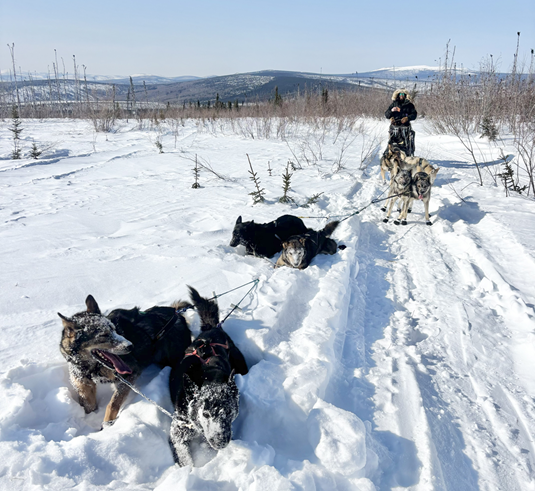
We left the Wickersham Dome trailhead in late morning, and after a few miles of mushing, stopped at a wide clearing to enjoy the expansive mountain view laid out before us. While there, a gentleman on a fat tire bike approached.
He said, “Do you know there is a group of kids coming down this trail on cross country skis? They are spread out over the next few miles. Fastest kids are in the front, of course.” He also told us the kids were from Watershed (a local charter school), and they had been camped out in the White Mountains for the past two nights.
I asked him, “Have they seen any other dog teams while they’ve been out here?”
“No,” he said. “You’ll be the first.”
I thought about that for a few seconds. “Do you know if the kids have had any instruction on how to pass dog teams?”
“I don’t know if their teacher talked to them about that or not,” he said. “I’m just a chaperone.”
As we parted ways, we were approached by the first few kids on skis. Since this section of trail was slightly uphill for the skiers, they had to work hard to make forward progress. Most of them were “skate-skiing,” which meant poling hard, and pushing off and to the side with their skis.
Thankfully, the trail was also fairly wide here and my team (the first in our group of three) was able to scoot over as the kids took up nearly the entire trail with their flailing skis. I shouted up to them as they got closer to me on my sled, “Hey! Slow down. You need to move over for dog teams.”
Noticeably shocked at being spoken to by a stranger, the kids stopped, pulled over, and apologized as I passed. “That’s alright,” I said. “Just so you know, when you’re passing a dog team, you’re supposed to stop and move over. Your skis and poles can hit the dogs.”
Uh-oh, I thought. These kids have no clue about trail etiquette.

Trail Etiquette 101
From Alaska to New Hampshire, the trail use rules are the same: Everyone yields to dog teams.
This means skiers, snowmachiners, bikers, hikers, skijorers, bikejorers, and snowshoers are all expected to stop and pullover when passing a dog team (or horseback rider) head-on.
Why do dog teams get priority on the trail?
Giving dog teams the right-of-way is a societal norm in Alaska that has likely been in place longer than statehood. As such, we can only guess at the obvious reasons why this is the standard practice:
- Dogs are more complex and sensitive than any other user on the trail. These are animals after all. They act primarily on instinct and experience. Their ability to reason and problem solve is extremely limited or simply non-existent. All other user groups (humans) have these abilities, and should be able to deploy to them while recreating on public trails.
- Dog teams are simply harder to manipulate due to the length of the sled, the gangline, and the sheer number of animals. It can be nearly impossible to move an entire team and sled off the trail and out of the way of other users, depending on trail width, snow depth, and the general compliance of the team.
- Dog teams behave better while in motion. It’s counter-intuitive if you’re not a musher, but a dog team is far more focused and obedient when they’re on the move. A stopped dog team is more likely to fan out and take up the width of the trail, making it very hard for any other trail-users to get by.
Why does it matter?
I estimate the dog brain to be as sophisticated as that of a 5-year-old child. And as such, it’s crucial for sled dogs to have positive experiences while on the trail. If they are approached by a loud, stinky snowmachine while out mushing, but the machine pulls off the trail and kills its engine for the dog team to pass, they learn that those machines are really nothing to be afraid of. Conversely, if they meet a skier with an aggressive dog who lunges and tries to bite them as they pass, then they learn that those two-leggeds and their pet dogs are something to be avoided while mushing. This can cause major problems, as fearful sled dogs will often try to turn the entire team around when they see something coming up in the trail they don’t like. Most mushers can tell you at least one story of a great dog who was “ruined” because they were clipped by a snowmachine or bit by a passing dog.

After passing the first round of skiers, I thought, Maybe this will be OK. These are good kids who want to do the right thing. It’s really too bad that none of the adults in this group talked to the kids about passing dog teams, but I guess I can do that.
We passed a few more skiers, some of whom even stopped and pulled over without being asked. Clearly they had been on public trails before, and probably been educated by a parent or other adult.
All was fine, until we hit a long, steep hill. For us, this would be an uphill climb. For the students, this was sure to be the longest, fastest downhill ride they would have before they reached the trailhead, and the end of their trip. The trail also narrowed here, as is common on steep hills, and we were penned in by chest-deep snow on both sides. The timing was going to be terrible for passing, but our options were limited. In my mind, continuing to mush up the hill was the best choice. Our teams had the socially-agreed-upon right-of-way, and stopping for a long time would likely only create more problems for everyone. (See third bullet-point above, or email me for a lengthier explanation).
But passing the skiers did not go well. Each kid who approached us was traveling at a high rate of speed, and seemed to be flying with total blinders on. Their wide-eyed gazes were aimed only at the trail in front of them — as if the dogs and I weren’t even there. Not a single one of them made eye contact with me.
And since the hill was steep, their cross-country skis were wedged into the “pizza” or “snow plough” formation, with the tips together and the backs of the skis spread far apart. Several of my dogs were hit in the wrists and feet by the backs of the skis. With no use for poles on the downhill, the skiers’ hands were tucked up near their armpits, and the bottoms of the poles were left to flail out to the sides. Several dogs were hit in the shoulders and faces by the poles. The kids had no clue as to the pain or trauma they were causing these dogs.


I frantically waved and shouted up to each of the skiers as they neared my team. “Hey!! Slow down!! You need to stop!!” Or some version of that. I chose my words deliberately and carefully, since I knew it would be hard for them to hear what I was saying. But I desperately hoped that my flailing arms and open mouth would at least break their gaze and they might slow down or stop to try and hear me.
But I got absolutely no response from any of them.
At some point it dawned on me that these kids were actually out of control. No doubt they were having a total blast, and probably didn’t care if they could stop or not, but perhaps the decision to stop wasn’t even within their reach anyway. That immediately presented a whole new set of safety concerns for them as individuals, and of course my dogs, so I did the only thing I could think of at the time. I reached out and grabbed onto the poles of the skiers as they went past. I held onto the pole while the kid slowly tried and failed to regain their balance and was forced to sit down in the snow. Having skied myself, I was confident that there was no serious danger in this, especially with myself holding onto the other end of the pole to provide ballast for the fall. At the same time, I stopped my team and turned to talk to the kid now on the ground between me and the team behind me. “Hey.” I said. “Dog teams have the right-of-way. You need to stop and move over.”
I repeated this exercise which each passing skier, and I even called the principal of the Watershed School while the whole thing was happening. I got his voicemail. I told him who I was, where I was, and the problem I was having. The message was long, and I even interrupted myself to shout at another passing skier. “Please,” I implored into the answering machine. “Next year, before your kids take this trip, make sure the teacher goes over trail etiquette with the students and how to pass dog teams. Also, some of these kids appear to be totally out of control, traveling at a high rate of speed, and there isn’t a single adult anywhere around.”
Apparently the teachers and chaperones had confidence in the maturity of the students to handle themselves on the trail. Unfortunately, they didn’t give them all of the skills or knowledge they needed to be entirely safe and responsible around other trail users.

I fully admit that the experience made me mad. I was frustrated and scared for my youngest, most impressionable dogs. Had they just learned that traveling away from home was dangerous? How would they react the next time we saw a skier? Did I just witness the ruin of my next generation of leaders?
For those parents or grandparents who feel outraged that their kids were treated in a way that felt unsafe or unfair, all I can say is: That is exactly how I felt, too.
Unlike dogs, middle-schoolers do have the ability to reason and make intentional changes. (Although I acknowledge that their brains are not fully developed until their late teens or twenties.) I also acknowledge that the kids I met on the trail that day had their own frightening experience. In addition to having their long, high-speed run interrupted, they were also yelled at by a total stranger. Fortunately, these kids have the ability to understand what was said to them, why, and how to behave differently in the future – if they choose to.